Question
What is a lead sheet? How to read one
The melody on one staff, the chords above it: the shortest complete way to write a song, and the page most working musicians read from.
A song on one page
A lead sheet is a song written down in its shortest complete form: the melody on a single staff, the chord symbols above it, and the lyrics under the notes when there are any. Everything else, the accompaniment, the bass line, the drum groove, is left to the players.
That is why it is the page jazz musicians read from in a fake book, the chart a session player is handed at a gig, and what a songwriter sends to a co-writer. The singer or the soloist reads the tune, the band reads the chords, and everyone fills in the rest.
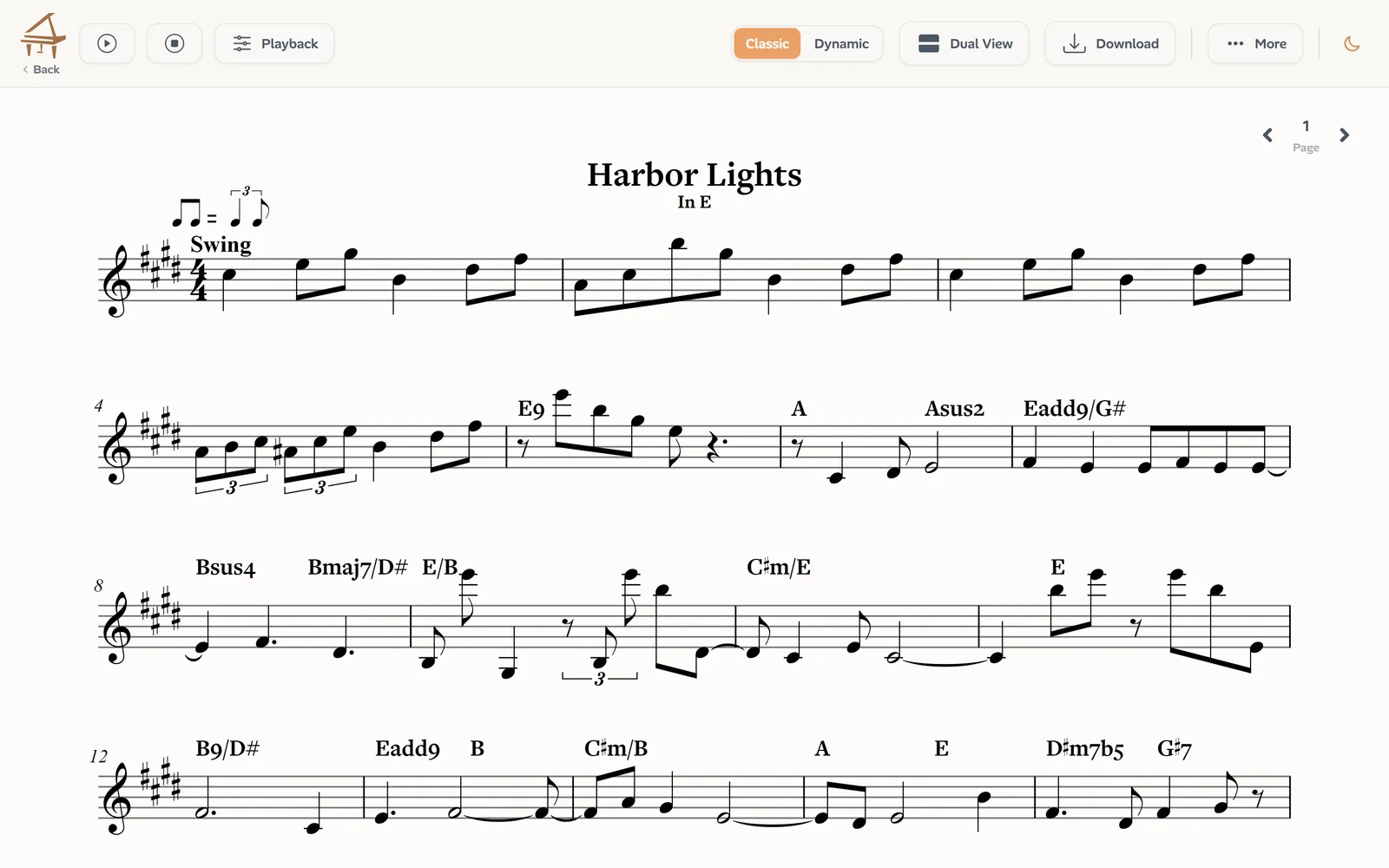
What is on a lead sheet
From the top of the page down:
- The title, the composer, and often a tempo or a style (Swing, Ballad, Bossa nova).
- The clef, the key signature and the time signature, as on any score.
- The melody, on one treble staff, with its rhythm written out.
- The chord symbols above the staff, placed over the beat where each chord starts.
- The lyrics under the melody, one syllable per note, when the song has words.
- The form: repeat signs, first and second endings, and markings such as D.C. al Coda that tell you where to go next.
The chord symbols you will meet
A chord symbol names the chord’s root and its quality. Here are the common ones, built on C:
| Symbol | Chord | Notes |
|---|---|---|
| C | C major | C, E, G |
| Cm | C minor | C, E♭, G |
| C7 | C dominant seventh | C, E, G, B♭ |
| Cmaj7 | C major seventh | C, E, G, B |
| Cm7 | C minor seventh | C, E♭, G, B♭ |
| Cdim or C° | C diminished | C, E♭, G♭ |
| Cm7♭5 or Cø | C half-diminished | C, E♭, G♭, B♭ |
| Csus4 | C suspended fourth | C, F, G |
| Cadd9 | C with an added ninth | C, E, G, D |
| C/E | C major with E in the bass (a slash chord) | E in the bass, then C, E, G |
A chord symbol stays in force until the next one. N.C. means no chord: the band stops and the melody goes on alone.
How to read one
Read the melody as you would any single line of music, and keep an eye on the chords above it: each one tells you the harmony from that beat until the next symbol. Before you start, look at the form, so the repeats and endings do not surprise you.
If a chord is unfamiliar, find its root first (the letter), then its quality (m for minor, 7, maj7, dim). With the ten symbols above you can read most lead sheets of popular songs.
How to play a lead sheet on the piano
A lead sheet does not tell the pianist what to play with each hand, which is its strength: the same page works at every level.
- To start: the melody in the right hand, the root of each chord in the left, on the beat where the chord changes.
- Next: the full chord in the left hand, held or repeated on the beats, under the melody.
- For accompanying a singer: chords in both hands in a rhythm that suits the style, and the bass note in the left, while the singer takes the melody.
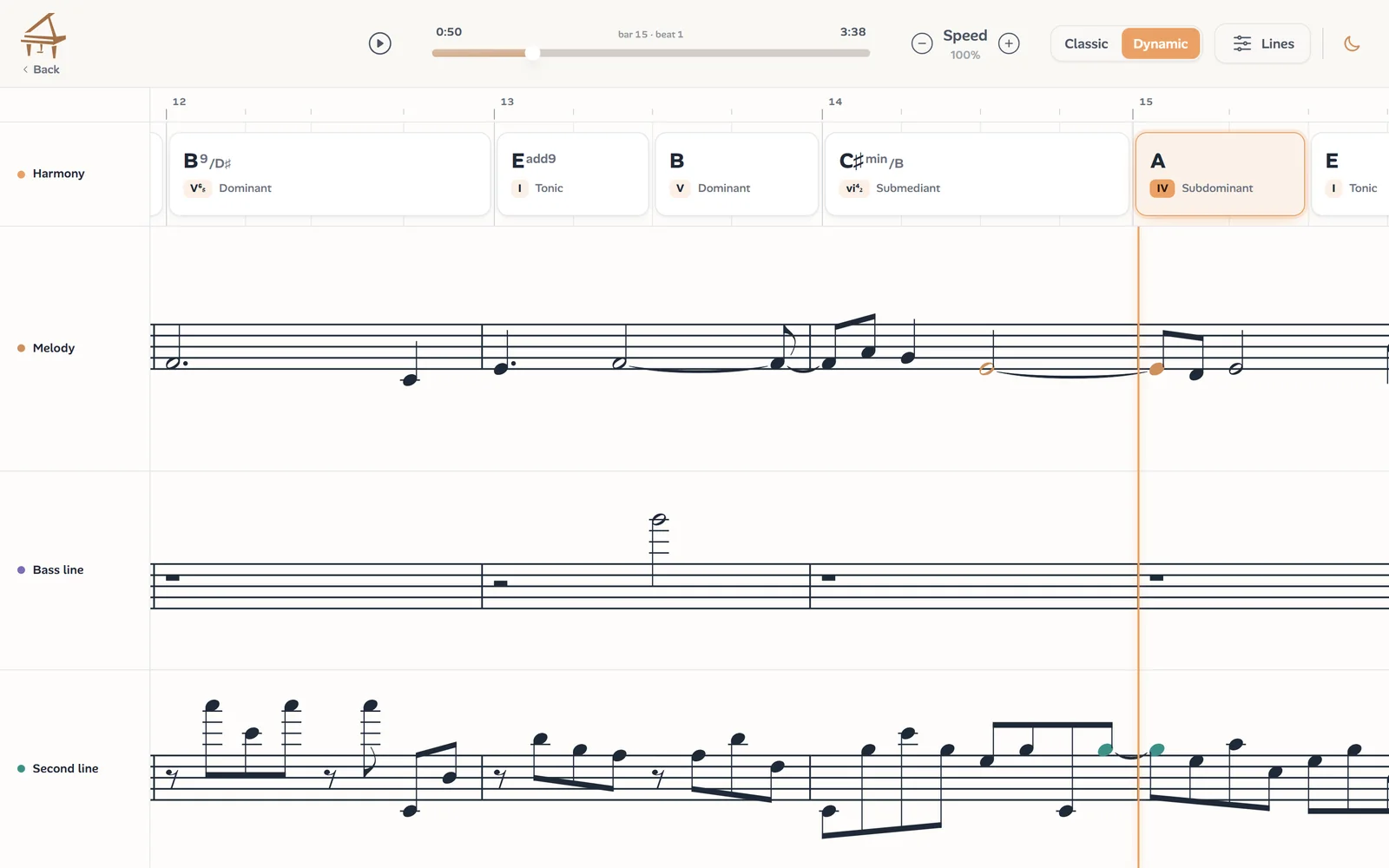
Ivory’s Complete view helps with the last step: it shows a second line and a bass line under the chords, so you can hear how the song’s own accompaniment moves.
Lead sheet, piano score or chord chart?
A piano score writes every note of both hands: you play exactly what is printed. A lead sheet gives the melody and the harmony and leaves the arrangement to you. A chord chart drops the melody too and keeps only the chords and the form, which is enough for a band that already knows the tune.
Which one you want depends on the music: a piano piece needs a piano score, a song is usually best as a lead sheet. Ivory writes both: piano transcription for a piano playing alone, lead sheets for songs.
Making a lead sheet from a recording
Ivory’s Lead Sheet mode (in beta) writes a lead sheet from a recording of a song: the melody and the chords, on the song’s own beat, with its key and its meter. It does not write the lyrics. You read it as pages in the Classic view, or in the Complete view, a timeline under the chords that scrolls with the recording and adds a second line and a bass line.
You can transpose it by semitones, play it back, and export a PDF, MusicXML or MIDI. Transcribe songs you may use: your own, or music in the public domain.
Frequently asked questions
Usually, when the song has words: one syllable under each note of the melody. Ivory’s lead sheets do not include lyrics: it writes the melody and the chords.
A fake book is a collection of lead sheets, one or two pages per song, that musicians use to play many songs from one book.
Yes: start with the melody in the right hand and the chord roots in the left, then add full chords as you learn them.
Because the melody is usually sung or played by a treble instrument. The bass and the chords are left to the players, so no bass staff is needed.
Move the melody and every chord symbol by the same interval. In Ivory you transpose by semitones, and the staff, the chord symbols and the playback follow.
Yes, with Ivory’s Lead Sheet mode, in beta: it writes the melody and the chords of a song from a file or a link. Without a credit, every transcription is a free preview: the first 30 seconds as falling notes and the first 8 bars of the score.
Make a lead sheet from a recording
Upload a song you may use or paste a link, and read the first 8 bars of its lead sheet for free.
Get the lead sheet